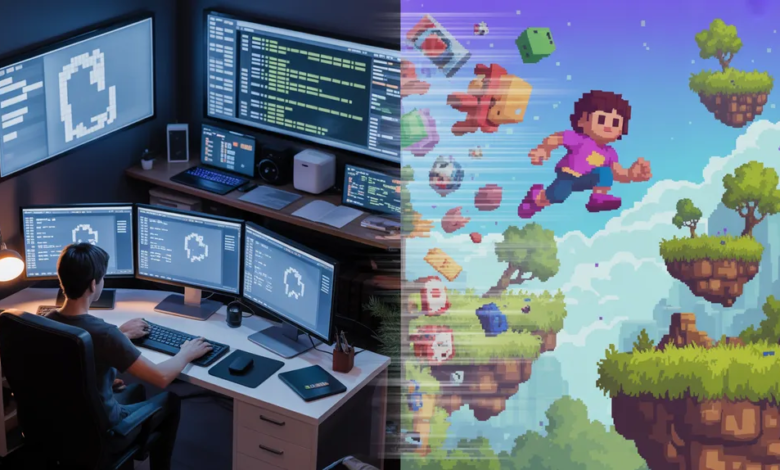
Have you ever experienced a game that seemed like it was thinking for itself, adjusting its difficulty level just as you were about to quit? For many years, we navigated through inflexible, scripted environments where minor NPCs used the precise same lines and levels never varied. It’s predictable early on, and will leave you really wanting a game world that reacts to your decisions in some significant way.
Fortunately, contemporary AI games are rewriting those antiquated rules and infusing the interactive with a completely new kind of energy. Today, developers are employing intelligent algorithms and novel platforms such as Astrocade to create living worlds that mold themselves around your playstyle. In this article, we take a look at how intelligent NPCs, ever-changing worlds and personalized play-styles are the future of gaming.
Smart Non-Player Characters
Smart non-player characters have completely changed how we interact with virtual worlds. Instead of repeating hardcoded dialogue, these characters pay attention to your actions and adapt their responses. If you help a village guard early on, they might remember your kindness hours later and offer critical aid during a difficult quest.
This shift creates natural, unscripted conversations that make virtual towns feel like real communities. You no longer feel like you are just triggering simple code routines. Every choice you make alters how these characters view you, adding real weight to every decision you make in the game.
Dynamic World Generation
Dynamic world generation allows environments to grow and change while you play. Rather than walking through handcrafted maps with fixed layouts, advanced algorithms shape landscapes, weather, and building interiors in real time. You get to explore unique, vast territories that look completely different from anyone else’s map.
This tech makes your beloved games feel like new even after a dozen playthroughs. You could go into a dungeon today that rearranges its corridors and hazards tomorrow according to how you performed in the past. It keeps you guessing and forces you to really explore, rather than just memorize.
A Personal Story
Personal story adaptation brings tailor-made narratives straight to your screen. Machine learning tools monitor your preferred playstyle, be it quiet stealth, diplomatic negotiation, or direct action and modify the main plot accordingly. The game generates story twists tailored to your individual playstyle on the fly.
For instance, if you always save innocent characters, the game may add a companion whose objectives align with your compassionate nature. In case of you prefer high-risk combat, the story shifts towards epic fights and strategic confrontations. This makes for a unique journey where your choices shape the outcome.
Enemy Strategies
Distinct enemy tactics mean that fighting is often more enjoyable than with traditional shooter or RPG mechanics. Enemies don’t just do simple guard patrols or predictable charge patterns anymore.They study your fighting style, exploit the weaknesses of your fighting style, and attack you in conjunction with their friends in flanking attacks.
If you spam the same sniper rifle or the same magic spell repeatedly, the enemies will find cover or raise shields. This ongoing change keeps you alert and makes you adapt. Every battle turns into a smart game of cat and mouse, rather than a test of muscle memory.
Endless Gameplay Possibilities in AI Games
Smart technology in games opens up endless possibilities of gameplay in every genre. Puzzle games can adjust their difficulty on the fly, so you never get bored or face an impossible challenge.While grand strategy simulators can generate realistic political crises driven by complex economic data.
The tools are evolving more and more, and the distance between players and game makers gets smaller and smaller every day. You are no longer just passive audience members following a pre-written storyline. You become a co-creator, a contributor, and a builder of your very own personalized gaming experience.
Conclusion
AI has changed the very ideation and development of game worlds. Game designers today can replace static scripts with dynamic mechanisms that construct worlds that learn, respond, and develop around you. Whether you like densely-packed stories, challenging battles or just wandering endlessly about, intelligent design means that every playthrough genuinely feels fresh.
They’re more capable, and the resulting games will be more adaptive, personal, immersive, and there will be more ways to share your experiences with people. If you’re aware of these areas, you’ll be able to hunt down some pretty good new games to really suit your play style when you head back in. Enter any of these dynamic worlds now or test your mettle against time-honored instructional classics such as Ben 10 Open World! and see as interactive technology continues to reshape the future of gaming.
See also: How Consultants Provide Objectivity During Business Restructures
Frequently Asked Questions
What are AI games?
They are dynamic worlds, smart characters, and customized story paths that evolve based on how you play, generated by machine learning, neural networks, and procedural algorithms in real-time.
Do these dynamic systems make games too hard for casual players?
Modern adaptive difficulty systems actually monitor your skill level in real time. So no, if you are having a tough time with a certain part, the game can discreetly reduce the difficulty to suit your level.
Are modern smart games expensive to play?
No, many modern smart games are free or low-cost, making them easy for players to enjoy.
Will machine learning replace human game developers?
Machine learning can assist game developers, but it is unlikely to fully replace human creativity, ideas, and decision-making.